

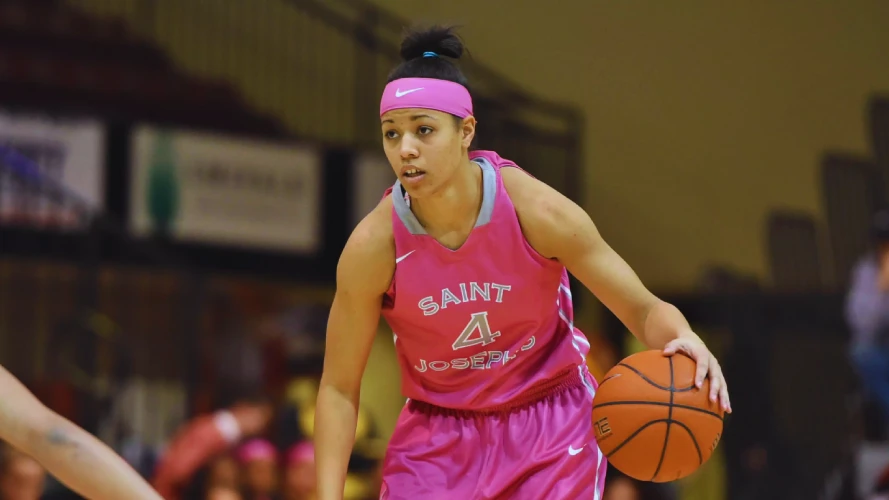
New York Liberty guard Natasha Cloud has once again placed herself at the center of a national conversation, this time not for her performances on the court but for her outspoken views on one of the most divisive global issues of the decade. After addressing the ongoing crisis in Gaza, Cloud became the target of both support and backlash across social media, standing firm on her position that the suffering of Palestinians cannot be ignored.
In a post that quickly spread across platforms, Cloud wrote, “Your constant misuse of this term is a danger to Jewish community members who face actual antisemitism. I believe that Palestinian lives matter as well. I won’t ever condone Netanyahu’s genocide and the starvation or killing of Palestinians.”
Her statement came in response to critics who accused her of antisemitism following her earlier remarks on the Israel Palestine conflict. Cloud’s message was clear. She was not attacking Jewish people but calling attention to what she described as a humanitarian catastrophe. Her use of the word genocide ignited strong reactions, with supporters applauding her courage and opponents accusing her of spreading harmful rhetoric.
This is not the first time Cloud has spoken out on social issues. Known for her activism, she has built a reputation as one of the WNBA’s most socially conscious athletes, frequently using her platform to address topics ranging from racial injustice to gender equality. But this time, her words struck a far deeper chord.
During an interview with Andscape on May 29, Cloud expanded on her stance. She spoke about the Gaza conflict with raw emotion, calling it an atrocity that too many people were afraid to name. “There’s a genocide happening. People are scared to use that word, but it is what it is. It’s a genocide. It’s ethnic cleansing. It’s intentional. We’re not paying attention,” she said.
For Cloud, activism is not a side pursuit. It is, in her words, a responsibility. “The least that I can do with this God given platform, which I know was meant for more than just winning games, is to serve my community and others,” she explained.
Her comments came at a time when many public figures have been hesitant to speak about the Gaza conflict. Fear of backlash, misinterpretation, and the politicization of every statement has made even the most socially aware athletes tread carefully. Cloud’s willingness to speak so directly, naming names and refusing to soften her message, was both rare and polarizing.
The response was immediate and intense. Some fans and analysts condemned her language, arguing that invoking the term genocide oversimplifies a complex geopolitical issue. Others accused her of ignoring the fear and suffering of Israeli civilians. Yet many others saw her as one of the few athletes brave enough to speak out on behalf of voiceless victims, praising her courage to stand firm in a storm of controversy.
Cloud’s remarks also reignited a larger conversation about what role athletes should play in public discourse. For decades, the world of sports was expected to exist apart from politics and activism. But that separation has eroded in recent years as athletes like LeBron James, Colin Kaepernick, Megan Rapinoe, and Enes Kanter Freedom have used their influence to address moral and humanitarian concerns.
Natasha Cloud fits squarely within that evolving lineage. Her approach is not cautious or rehearsed. It is emotional, faith driven, and unfiltered. She is not content to exist solely as an athlete. She sees herself as a vessel for something larger, even when it brings heavy consequences.
Her critics argue that sports should remain neutral, but Cloud’s supporters counter that neutrality in the face of suffering is a privilege many cannot afford. In their view, she represents a new generation of athletes unafraid to sacrifice popularity for principle.
It is also worth noting that Cloud’s words are being echoed far beyond the sports community. Across social media, activists and commentators have shared her statements as part of a broader global dialogue about Gaza and the humanitarian cost of prolonged conflict. The visibility of a professional athlete speaking so frankly has amplified attention in ways traditional media often cannot.
Despite the criticism, Cloud has remained calm and unwavering. She has not deleted her posts or walked back her comments. Her focus appears to remain on truth as she sees it. The message she projects is one of moral consistency, one that places compassion above comfort.
Her stance has also highlighted the difficult line public figures must walk in an era of rapid judgment. Every statement is dissected, every word turned into a headline, and every expression of conscience measured against political loyalties. For Cloud, that reality seems irrelevant. She has chosen to speak from conviction rather than calculation.
The story of Natasha Cloud’s comments on Gaza is not simply about politics or religion. It is about what happens when an athlete refuses to stay silent in a world where silence often feels safer. It is about courage in a climate of fear and about choosing empathy even when empathy is controversial.
Whatever one’s position on the conflict, her willingness to risk reputation for belief has reignited an age old question in sports and society alike. Should athletes speak out on global issues or remain within the boundaries of their profession. Cloud’s answer has been made clear through both her words and her actions. She believes that silence is not neutrality but complicity.
As the discussion continues, Natasha Cloud stands as a symbol of a new era in sports culture, one where the court is no longer just a place to compete but a platform to confront the realities of the world beyond it.